
Building Web Applications in 2026 from scratch
Building products has fundamentally changed in the last few years at a staggering pace.
Over the past few years, AI hasn’t just made it easier to ship - it’s fundamentally changed how we build. We’re no longer starting from scratch, and we’re not limited to a basic template either. Instead, we begin with something far more advanced: a foundation shaped by the exact technologies we want to use. From there, our role shifts to guiding, refining, and steering. The focus isn’t purely on writing code anymore - it’s on using AI to augment yourself and amplify your thinking.
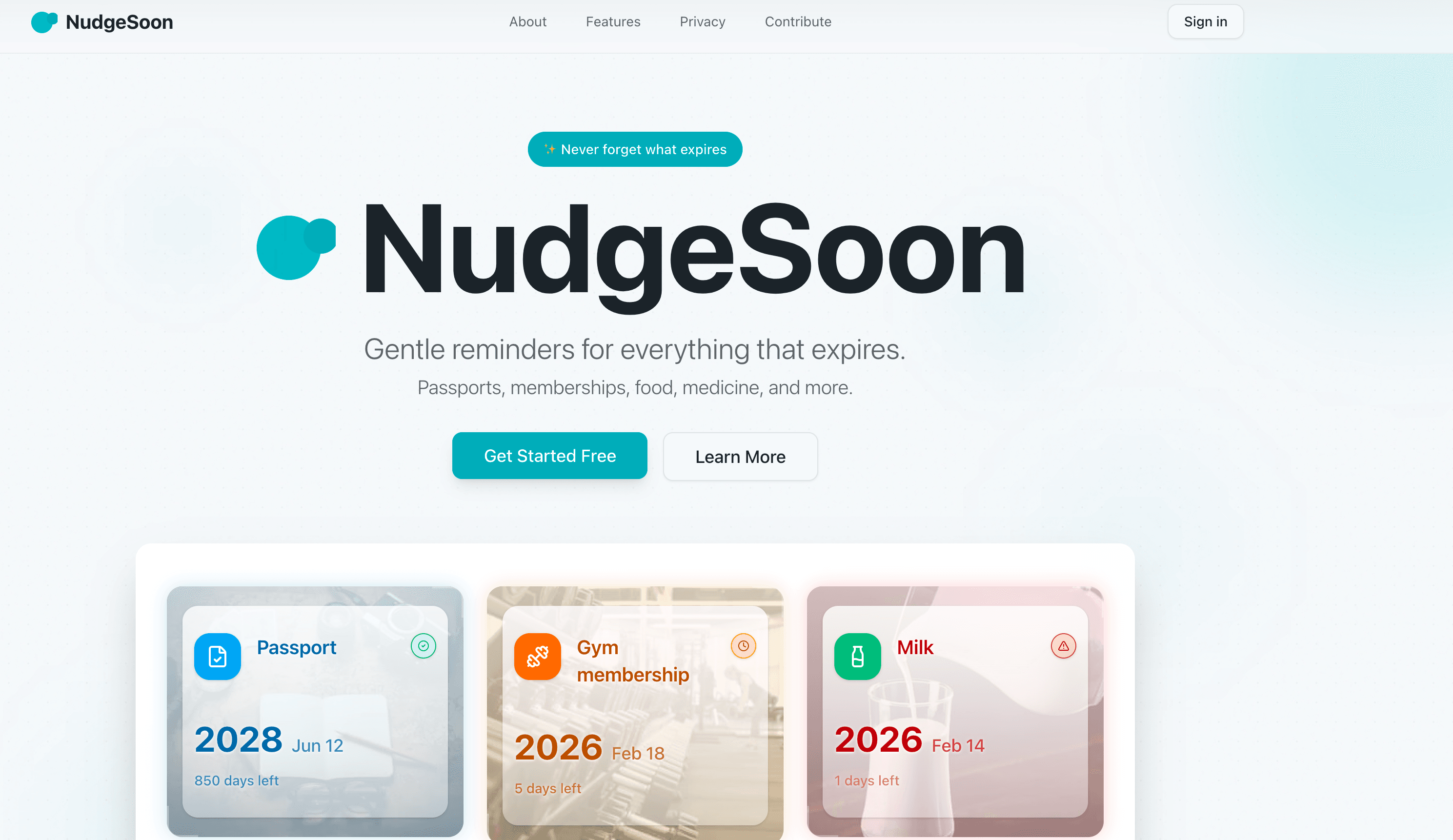
I made NudgeSoon because last year I forgot to renew my car registration and got a hefty fine.
This experience made me realise something. There is no clean, focused product that tracks everything that expires in one place. Registrations, subscriptions, insurance, passports. All the small but important things that are easy to ignore until they become urgent.
So I decided to build it and use all the new cool stuff we have access to in 2026.
I gave myself three days to ship something real.
How I Built It
ChatGPT became my thinking partner. Whenever I had an idea around features, naming, positioning, or UX flow, I used it to pressure test my thinking. It helped me refine ideas and spot gaps.
Claude felt like a senior engineer. Even with loose prompts, it produced thoughtful architecture and clean implementations. It often structured things in ways that surprised me in a good way. Good prompts become good output, bad prompts somehow also became good output.
The only downside was hitting the daily limit, which forced me to slow down and think more carefully before prompting.
Cursor felt more like a junior developer. When I gave it proper context and clear instructions, it was excellent. When I was vague, the output suffered. It was more of a reflection of my abilities to prompt.
For smaller UI tasks and component tweaks, it was especially useful. Using the browser to drag components directly into the context window felt natural. Over time, I added rule files and improved my prompts, and the quality improved immediately.
Clear inputs create better outputs.
The Stack
I kept the stack simple but solid.
The app is built with Next.js, styled with Tailwind and shadcn, and deployed on Vercel. That combination removes a lot of friction. Deployments are fast, previews are automatic, and I do not have to think too much about infrastructure.
For the database, I used Postgres hosted on Neon. It was easy to set up, works nicely with serverless environments, and feels like a modern default for projects like this.
I also added Playwright for automation and testing. Since the whole product revolves around reminders and dates, I wanted confidence that flows actually work. Having end-to-end tests gave me that safety net, especially when iterating quickly with AI in the loop.
Claude helped think through structure. Cursor helped implement parts of it. I reviewed everything, cleaned it up, and rewrote sections where needed.
AI accelerated the work, but I stayed responsible for the decisions.
The Hardest Part
The hardest part was not backend logic. It was UX.
Early on, my prompts were vague. I would ask for something clean or modern and hope for the best. I quickly realised, that does not work. It's gambling. The better the prompts, the better the results.
Once I started being specific about color palettes, spacing, icon style, and interaction patterns, everything came naturally.
AI does not replace taste. It amplifies it.
If your direction is unclear, the output will be unclear too.
Shipping V1
day 1: initial build, day 2: make it look pretty and day 3: polish, test and launch.
This is just version one, it's an MVP but some of the things I'm planning for the future are: a browser extension, email parsing, calendar sync, smarter reminders, and eventually a mobile app.
The first thing I did after launching was to signup and put my car registration among other things.
I realised the real bottleneck in 2026 is not typing code. It is clarity.
If you know what you are building and why, AI helps you move at an exponential pace. If you don’t, you are just digging a hole faster. As a developer, it enhances your ability to deliver, but only if you have solid foundations. It is a growth multiplier, not a replacement.
The responsibility for what ships is still yours. You are accountable for every line of code that reaches production - you just got there faster. And that is a good thing. It gives you more time to think, design, and focus on the parts that really matter.